
Introduction
For much of human history, space represented the ultimate frontier—a realm beyond the reach of nations, economies, and political systems. During the twentieth century, however, technological advances transformed space from a subject of scientific curiosity into an arena of geopolitical competition. The original Space Race between the United States and the Soviet Union became one of the defining features of the Cold War, culminating in the historic Apollo 11 Moon landing in 1969. ‘That competition demonstrated not only technological achievement but also national prestige, ideological influence, and strategic capability.
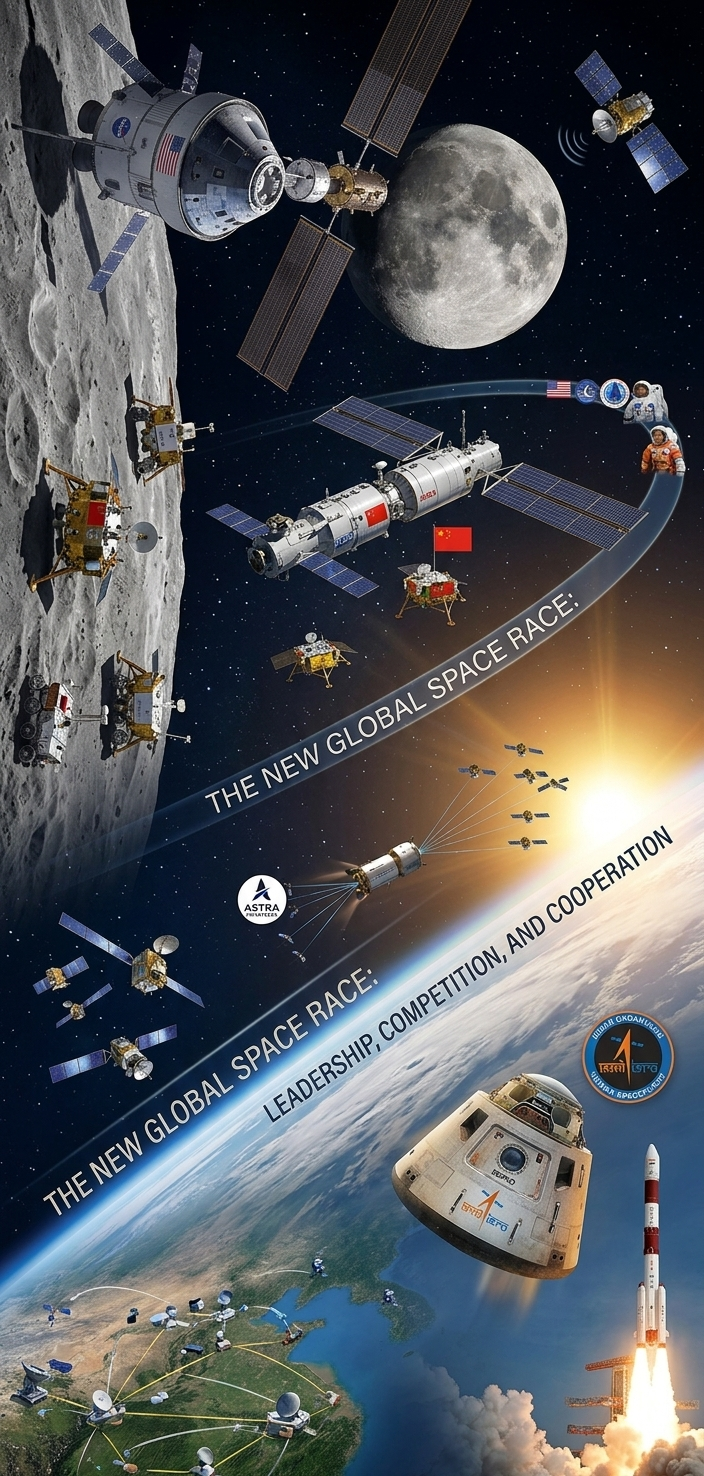
‘Today, more than half a century later, a new space race is unfolding, Unlike its Cold War predecessor,
the contemporary competition is far more complex. It involves multiple countries, private companies, commercial interests, scientific ambitions, military considerations, and emerging technologies, Space is no longer viewed solely as a domain for exploration; it has become an increasingly important component of economic development, national security, communications infrastructure, and international influence.
Governments around the world are investing heavily in lunar missions, satellite systems, deep-space ‘exploration, launch capabilities, and advanced space technologies. At the same time, private ‘companies are transforming the economics of space activities, lowering costs and expanding access to orbital and interplanetary missions. The result is a rapidly evolving environment in which cooperation and competition coexist.
‘The new global space race is therefore about far more than reaching distant destinations. It reflects broader questions about technological leadership, strategic power, resource access, economic ‘opportunity, and the future governance of humanity’s activities beyond Earth.
From the Cold War to the Multipolar Space Age
‘The original Space Race emerged from the geopolitical rivalry between the United States and the Soviet Union. Space achievements became symbols of technological superiority and national capability, Milestones such as the launch of Sputnik, the first human spaceflight, and the Moon landing carried significant political and strategic meaning.
Following the end of the Cold War, many observers anticipated a more cooperative era in space exploration, international partnerships expanded, most notably through the development of the International Space Station (ISS), which brought together multiple countries in a shared scientific endeavor.
However, the twenty-first century has witnessed a renewed emphasis on competition. This shift does not necessarily indicate a return to Cold War dynamics. Rather, itreflects the emergence of a multipolar space environment in which numerous actors pursue diverse objectives.
The United States, China, Russia, India, Japan, and European nations all maintain significant space ambitions, Meanwhile, countries in the Middle East and other regions are expanding their space programs, The growing participation of private companies has further transformed the landscape, creating a more dynamic and competitive ecosystem.
Why Space Matters Again
The renewed interest in space is driven by a combination of scientific, economic, strategic, and political factors.
Scientific exploration remains a powerful motivation, Space missions contribute to our understanding of the universe, planetary systems, climate processes, and the origins of life. Advances in astronomy and planetary science continue to generate valuable knowledge with implications for multiple disciplines.
Economic opportunities also play a major role. Satellite services support communications, navigation, weather forecasting, agriculture, logistics, financial systems, and countless other sectors. The global economy increasingly depends on space-based infrastructure.
Strategic considerations have become equally important. Satellites enable military communications, intelligence gathering, navigation, and surveillance. Consequently, access to space capabilities
Finally, space achievements continue to carry symbolic value. Successful missions can enhance national prestige, demonstrate technological competence, and strengthen international influence.
The convergence of these factors explains why space has once again become a priority for governments and institutions around the world.
The United States and the Evolution of Space Leadership
The United States remains one of the most influential actors in the global space sector. Decades of investment in research, exploration, and technological development have created an extensive ecosystem involving government agencies, universities, research institutions, and private companies.
American space leadership has traditionally been associated with scientific innovation and exploration. Programs focused on planetary missions, deep-space observation, and human spaceflight have contributed significantly to global scientific knowledge.
In recent years, the United States has also emphasized returning humans to the Moon and developing capabilities that could support future missions to Mars. These initiatives reflect broader ambitions to maintain leadership in exploration while advancing scientific and technological objectives.
At the same time, the American approach increasingly incorporates partnerships with private companies. This model has contributed to rapid innovation, lower launch costs, and expanded commercial opportunities within the space sector.
China’s Expanding Space Ambitions
China has emerged as one of the most significant space powers of the twenty-first century. Over the past two decades, the country has invested heavily in launch systems, satellite technologies, lunar exploration, and human spaceflight.
Chinese achievements include robotic lunar missions, Mars exploration efforts, and the development of an independent space station. These accomplishments demonstrate the country’s growing technical capabilities and long-term commitment to space development.
China’s space program reflects broader national objectives related to technological advancement, scientific research, and strategic influence. Space achievements are often viewed as indicators of national progress and innovation capacity.
The expansion of China’s space activities has contributed significantly to the increasingly competitive nature of the global space environment. At the same time, China continues to participate in scientific collaborations and international initiatives, highlighting the coexistence of competition and cooperation within the space sector.
India and the Rise of Emerging Space Powers
India has become one of the most closely watched participants in the contemporary space race. Through a combination of scientific expertise, cost-effective engineering, and sustained investment, the country has achieved notable successes in satellite deployment, planetary exploration, and lunar missions.
achieve ambitious objectives. The country’s space program has contributed to telecommunications, weather forecasting, disaster management, navigation, and scientific research.
Beyond India, several other countries are expanding their space activities. Nations in the Middle East, Southeast Asia, and Latin America increasingly view space technologies as tools for economic development and technological advancement.
The growing diversity of participants reflects a broader democratization of space capabilities. Access to space is no longer limited to a small number of major powers.
Europe and International Collaboration.
Europe occupies a unique position within the global space landscape. European space activities are characterized by extensive cooperation among multiple countries, research institutions, and industrial partners.
European programs emphasize scientific research, Earth observation, satellite navigation, climate monitoring, and technological innovation. Collaborative approaches have enabled Europe to maintain significant capabilities while sharing costs and expertise across national boundaries.
The European experience illustrates how international cooperation can support ambitious space objectives. It also demonstrates that competition in space does not necessarily preclude collaboration on scientific and technological initiatives.
The Commercial Space Revolution
One of the most significant developments in the modern space race is the rise of private-sector participation. Historically, space activities were dominated by governments due to their high costs and technical complexity.
Advances in technology, combined with new business models, have transformed this situation. Private companies now play major roles in launch services, satellite deployment, communications infrastructure, Earth observation, and emerging commercial activities.
The commercial space sector has contributed to increased competition, reduced launch costs, and accelerated innovation. Reusable rocket technologies, expanded satellite networks, and private investment have fundamentally changed the economics of space operations.
This transformation has broadened access to space and created opportunities for new participants across multiple industries.
The Strategic Importance of Satellites
Satellites represent one of the most important elements of modern space activity. They support a vast range of civilian and military functions that underpin contemporary societies.
Communications networks rely heavily on satellite infrastructure. Global navigation systems enable transportation, logistics, and location-based services. Weather forecasting, environmental monitoring, and disaster response depend on satellite-generated data.
Military organizations also utilize satellites for intelligence gathering, communications, navigation, and operational planning. Consequently, space-based infrastructure has become a critical component of national security.
The Return to the Moon
The Moon has reemerged as a major focus of international space activity. Multiple countries are pursuing lunar missions aimed at scientific research, technological development, and long-term exploration.
Interest in the Moon is driven by several factors. It offers opportunities to study planetary history, test technologies for future deep-space missions, and potentially utilize local resources to support exploration activities.
The return to lunar exploration is often viewed as a stepping stone toward more ambitious objectives, including human missions to Mars and other destinations within the solar system.
While competition exists regarding lunar achievements, many experts emphasize the potential benefits of international cooperation in supporting sustainable exploration efforts.
Space and National Security
Space is increasingly recognized as a strategic domain alongside land, sea, air, and cyberspace. Military organizations around the world depend on space-based assets for communications, navigation, surveillance, and intelligence.
As a result, governments pay close attention to developments that could affect access to or control over critical space infrastructure.
National security considerations influence investment decisions, technological development, and international partnerships. At the same time, policymakers generally recognize the importance of preserving the stability of the space environment.
Managing security concerns while maintaining peaceful uses of space remains one of the central challenges of contemporary space governance
Governance Challenges in Space
The rapid expansion of space activities raises important governance questions. Existing international agreements provide a foundation for peaceful cooperation, but many contemporary challenges were not anticipated when these frameworks were developed.
Issues such as orbital congestion, space debris, resource utilization, commercial operations, and emerging technologies require ongoing discussion and coordination.
As more actors enter the space sector, effective governance becomes increasingly important. Balancing national interests, commercial opportunities, scientific objectives, and international responsibilities will be critical to maintaining a stable and sustainable space environment.
The Future of the Global Space Race
The coming decades are likely to witness continued growth in space activities. Advances in propulsion systems, robotics, artificial intelligence, satellite technologies, and commercial infrastructure may expand what is technically and economically feasible.
Competition for technological leadership will remain a significant feature of the space landscape. At the same time, the scale and complexity of many space challenges may encourage greater collaboration among governments, companies, and research institutions.
Future developments may include permanent lunar infrastructure, expanded commercial services, advanced Earth observation systems, and deeper exploration of the solar system.
The trajectory of these developments will influence not only scientific progress but also economic growth, security considerations, and international relations.
Conclusion
The new global space race represents one of the most important technological and geopolitical developments of the twenty-first century. Unlike the Cold War-era competition that centered primarily on two superpowers, today’s space environment is characterized by multiple participants, diverse objectives, and increasing commercial involvement.
Space has become essential to modern economies, national security systems, scientific research, and technological innovation. Consequently, leadership in space activities increasingly reflects broader forms of national power and international influence.
Yet the future of space will not be determined by competition alone. The challenges associated with exploration, sustainability, governance, and scientific discovery often require cooperation that transcends national boundaries. The most successful space initiatives may therefore emerge from a combination of rivalry, partnership, innovation, and shared ambition.
As humanity expands its presence beyond Earth, the decisions made today regarding space policy, investment, and governance will help shape not only the future of exploration but also the future structure of international relations in an increasingly interconnected world.